How to Plan Low-Voltage Landscape Lighting for Your Home
The most beautiful landscape lighting rarely comes from using the most fixtures. It comes from deciding what deserves light, what should remain in shadow, and how each layer works together. A well-planned low-voltage system can make the approach to a home feel more welcoming, give planting depth after sunset, and reveal architecture without overwhelming it.
Begin with the experience, not the fixture count
Walk the property at dusk and think about how the home is actually experienced after dark. Start with arrival points, paths, steps, outdoor living areas, significant trees, planting and architectural details. The goal is not uniform brightness. It is a composition.
A restrained plan usually feels more sophisticated than lighting every object. Preserve areas of darkness between illuminated features so the eye has contrast and the landscape retains depth.
Build the design in layers
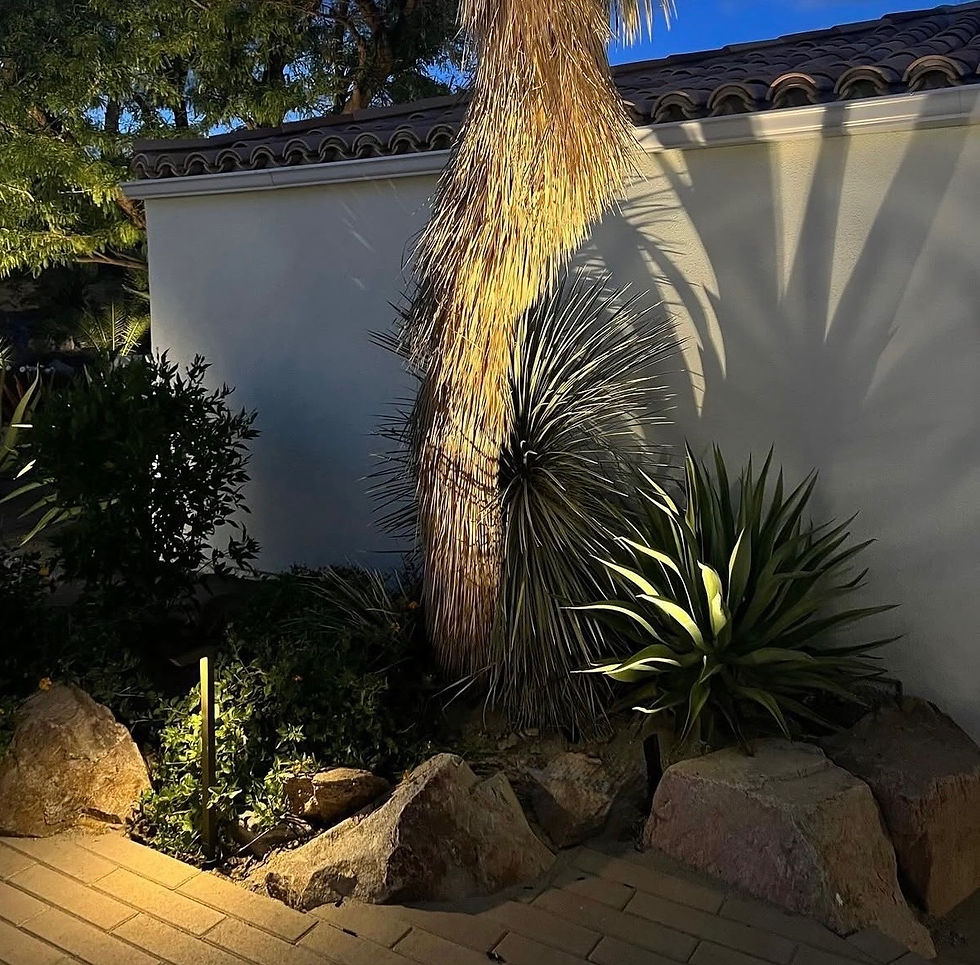
Path and area lights provide gentle guidance through walks, gardens and planting beds. Directional lights add emphasis to trees, walls and architectural features. In-ground fixtures can create discreet uplighting where a visible fixture would interrupt the landscape. Step and hardscape lights integrate illumination into stairs, walls and built elements.
These layers do different jobs. Used together, they create a landscape that feels dimensional rather than simply bright.
Choose a warm, consistent light
For residential landscapes, 2700K and 3000K are both warm-white choices. Centurion favors 2700K for the warmth it brings to planting, stone, wood and residential architecture. The more important design principle is consistency: a deliberate color palette generally feels calmer than unrelated color temperatures scattered across the property.
Plan the low-voltage system
A standard low-voltage landscape lighting system uses a transformer to reduce household power to the lower voltage used by the fixtures. The transformer typically connects at a standard outdoor outlet, and low-voltage cable distributes power through the landscape.
Add the wattage of the fixtures you plan to connect and select a transformer with adequate capacity. As a simple Centurion planning rule, keep connected fixture wattage at or below about 80% of the transformer's rated capacity. Run length, wire gauge and fixture distribution also influence voltage drop, especially on larger properties.
Design for installation before you buy
Identify the transformer location, approximate cable routes and fixture positions before ordering. That makes it easier to estimate cable, connectors and transformer capacity and reduces improvisation during installation.
Low-voltage systems are approachable enough that many homeowners work with a landscaper, handyman or local low-voltage professional. Experienced homeowners may also choose to install a straightforward system themselves.
Choose materials as carefully as the light
Landscape fixtures live outside year after year. Material is therefore part of the design decision, not merely a specification. Centurion landscape fixtures are crafted from solid brass or copper in Southern California and are designed to become a lasting part of the property.
Natural copper can evolve with exposure, while finished brass provides a substantial foundation for darker architectural finishes. The result should look considered in daylight as well as after dark.
A simple planning sequence
First decide what should be illuminated. Then assign the appropriate fixture type to each feature. Establish fixture locations, total the connected wattage, choose the transformer, plan cable routes and connections, and finally adjust aiming and intensity after sunset. The last step matters: landscape lighting is best judged in the landscape, at night.


Comments